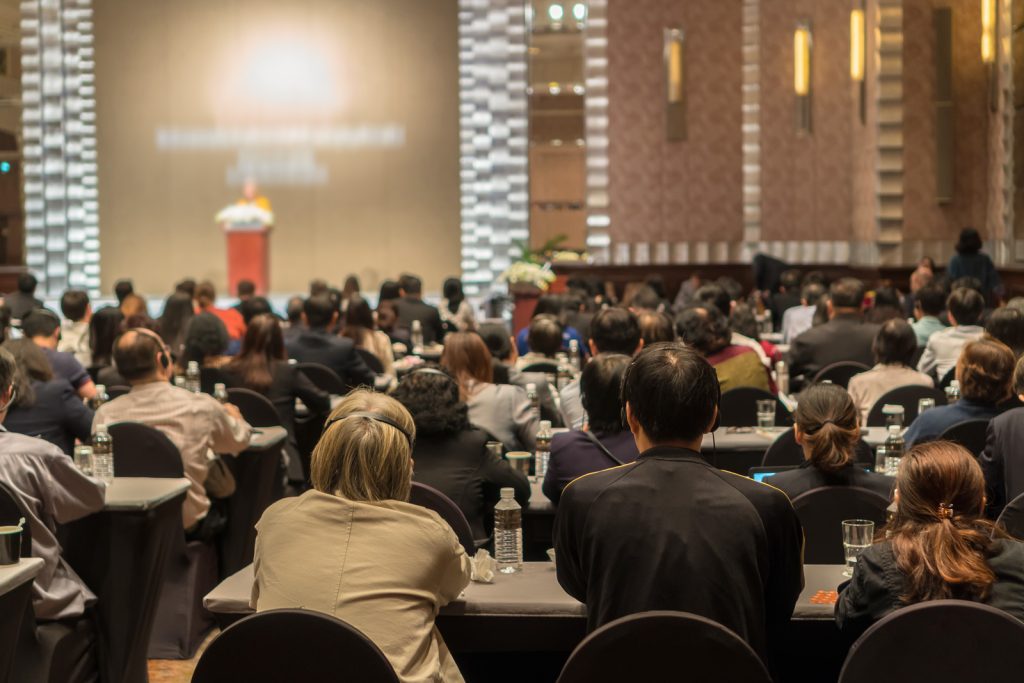
Imagine you’re organizing an international conference. The keynote speaker – an expert whose research could change how your industry thinks – delivers a powerful, nuanced talk. Half the audience follows closely. The other half, relying on a translation app, reads literal, staccato sentences that miss the subtle humor, the emphasis, and the underlying tone. Then, during a Q and A session, a follow-up question is misinterpreted, and confusion sets in. What was designed to be an international convergence or minds and opportunity for connection becomes a patchwork of misunderstandings and puzzlement.
This scenario perfectly embodies the difference between an automatic translation tool and a professional interpreter. Nobody can deny that machine translation has made enormous progress, and it’s a great tool to have to gather the gist of a foreign-language text or figure out what to order from a menu. However, when it comes to events, the stakes are higher and often contain cultural and emotional factors that mean a human, professional interpreter pays off – and far exceeds the capabilities of software that, at its best, only scratches the surface of meaning.
In this article, we’ll look at the complexities underlying the process of interpretation and why a professional linguist brings expertise that transforms basic understanding into true communication and real opportunities.
How timing and nuance affect communication
While the words themselves are clearly important, communication also goes beyond this; tone and rhythm, for example, are essential to how a message is received, and there’s always a subtext and context to consider, too. From French interpreters to Thai interpreters, professional linguists will always listen for these subtler elements that make communication more impactful.
That might be sarcasm or irony (particularly common in British English, Russian, and Spanish, but less well received in Japanese, Korean, or Mandarin), rhetorical questions that can only be understood in context, or simply the timing of a pause or hesitation, which can carry as much meaning as the words themselves. This notion of timing is particularly acute in languages such as Japanese, where silences and pauses are often imbued with meaning. That’s why Japanese interpreter services are so essential for making sure these subtler elements of communication are not lost.
How cultural knowledge impacts translation
Shared cultural knowledge is an important layer of meaning that’s difficult to pass on to someone from a different background. That’s because, as well as direct meanings, words also bring along a whole set of connotations and assumptions, whether that’s a joke, a reference from a shared history, or the implied level of formality.
These connotations and assumptions vary from culture to culture. Professional interpreters pick up on these invisible cues and symbols, adapting the phrasing of their translation accordingly. In taking this approach, they not only capture the appropriate tone and demonstrate the necessary level of respect, but also steer well clear of the cultural faux-pas that a word-for-word translation can accidentally introduce.
How sector experience makes all the difference to your event
When it comes to conferences, summits, or trade shows, not all interpreters are equal. An interpreter with sector-specific expertise adds more than just linguistic skills; they also understand the technical terms, industry jargon, as well as have familiarity with all the latest acronyms and protocols. This means your international colleagues hear more than just the words; they’ll also be able to grasp the underlying ideas and concepts under discussion.
For instance, let’s say your event is a multilingual medical symposium, where many of the world’s eminent physicians are gathered to discuss the latest pioneering approaches and breakthroughs. An interpreter with medical expertise will be better positioned to deliver clear, accurate translations of medical content compared to an (equally talented) interpreter whose background lies in legal language. Working with an interpreter who knows your field inside out ensures that your event participants receive a precise translation, rather than having to fumble through with guesswork and piecing together confusing snippets.
How Capital Linguists outperforms Google Translate every time
Google Translate might well give you a correct sentence, and you are likely to understand the overall meaning. However, a good interpreter gives you the meaning, timing, and emotion, leading to more effective communication and understanding by delivering the translation in a way that invites the intended reaction.
At Capital Linguists, we partner with a network of highly skilled, accredited linguists, who bring subject expertise to every job. Our event interpreters work on conferences, press events, or any other multilingual forums, delivering smooth, professional interpretation every time. To discuss your next event – and find out how the team at Capital Linguists can guarantee it runs smoothly – don’t hesitate to reach out today!
